
The multiplications for each level added together show that this learner will know only 64% of the words in this text.
You can find your learner's VP using 'Levels' type tests on Lextutor at tests. You can find a text's VP using the VP routines accessible from the VP domain where you are now. You choose a matching test and VP scheme. For example, you would use the Classic Levels Receptive test for your learners if you intend to use the Classic VP to select a text, or the 14k Vocabulary Size Test (VST) if you were planning to use the BNC or BNC/Coca VP schemes. (Note that you can also make your own frequency based Yes-No tests in under ten minutes here.)
With text VP and learner VP both known, you should be able to make a useful match. Matching text VPs to learner VPs is usually a matter of focusing on the first couple of 1000-levels. For example, if your learners take the 14k Size Test and score (this is a typical score) above 85% at the first thousand level (K1) but less than 50% at 2k and beyond, then the 2k layer of the English lexicon is probably their current growth zone. This means that these learners will find a text of 95% K1 items (inclusive proper nouns) fairly manageable, but will struggle with a text with a significant component of 2k and beyond.
Such predictions depend of course on text type to some extent as well as learners' topic knowledge.
For a more complete matching procedure, as could be needed for more advanced learners, once you have test scores for learners and VPs of some candidate texts, you can simply multiply your learners' knowledge at a particular k-level against the proportion of a candidate text that is at each k-level and then add up the products. For example, suppose your learner knows 70-50-40-20% at K1-k2-k3-k4 respectively, and you are thinking of giving him or her a text with VP 80-10-5-5% at K1-k2-k3-k4. You could eyeball the data and conclude this learner would find this text challenging. Just the K1 component tells you this - your learner knows only 70% of the words that comprise 80% of the text, and half or fewer of the words from the remainder. Or you could do the math (simple multiplication and an add-up) and get a clearer idea of how challenging.
The multiplications for each level added together show that this learner will know only 64% of the words in this text.
As a rule of thumb, learners can not do much with a text whose words they know fewer than 90% of, and full comprehension requires about 98%. From 90% to 95% known words, a text can be used intensively (for dictionary work, contextual inference, re-reads, etc.) From 95% to about 98%, it can be read for meaning with resources, or read fast enough to be used for fluency building. Above 98% the text can be used for 'reading to learn' rather than 'learning to read' with minimal look-ups or deflections of attention from language to meaning.
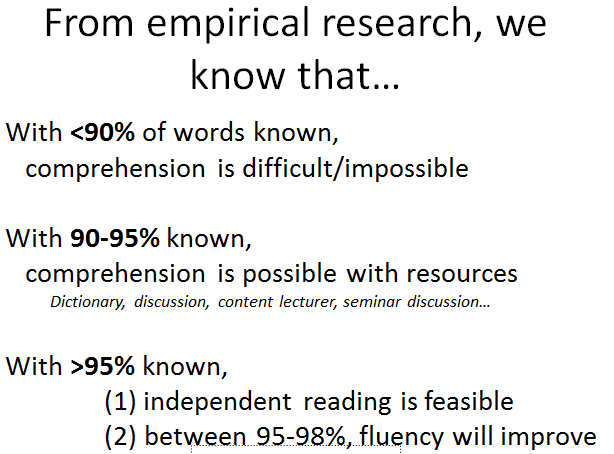
(3) Between 95 and 98% comprehension will improve.
(Both figures from TC's GLOCALL 2015 plenary ppt)